We put AI to the test with a food photo shoot-off. For each round, we gave Kling, a popular AI image tool, a prompt describing the scene and put the result next to a real photo from our studio. Here are the four rounds, the results, and why real photography still wins for food brands.
Round 1: Apple pie
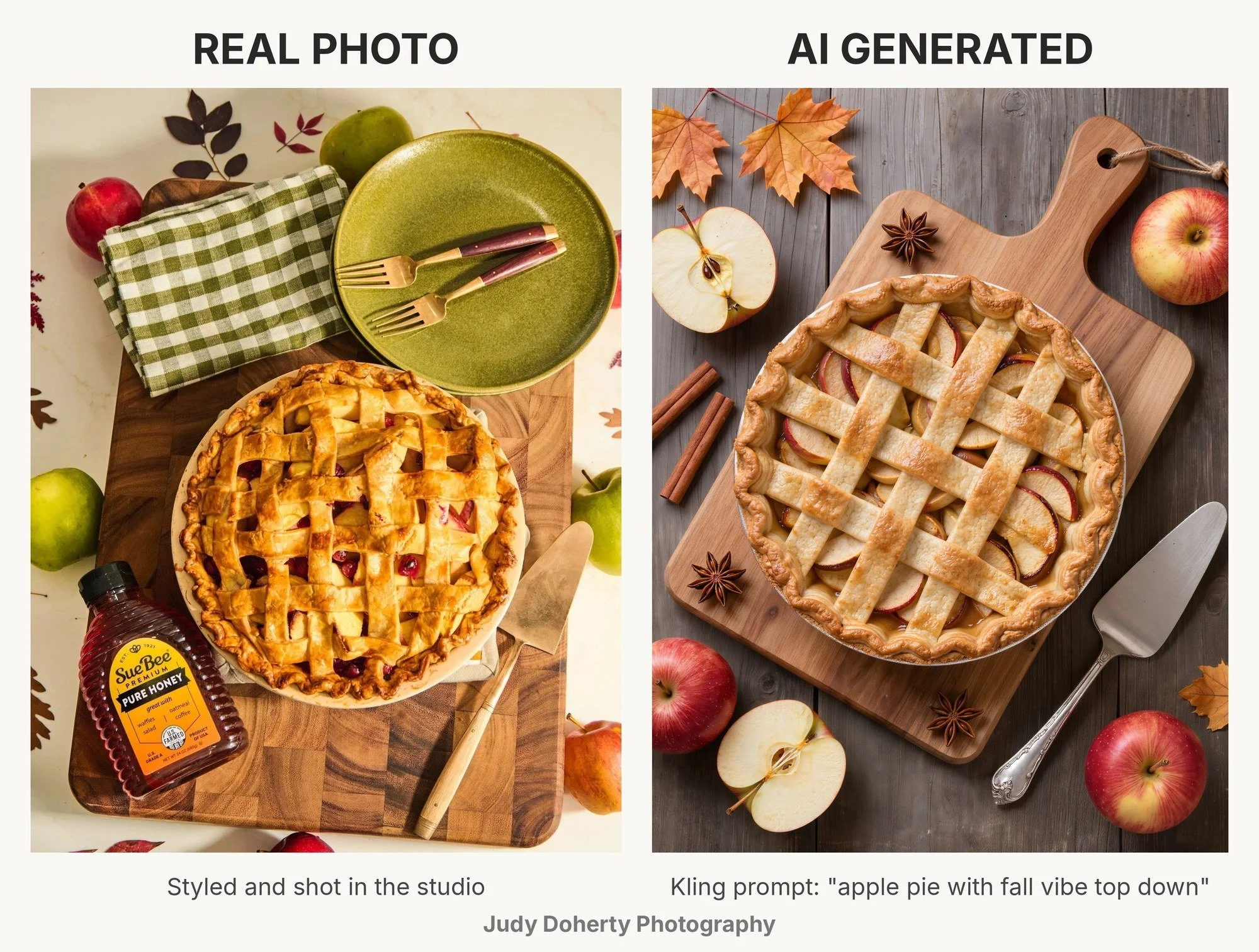
The prompt was simply "apple pie with fall vibe top down." The real pie has a hand-woven lattice with a glossy egg wash, cranberries bubbling through and deeply browned edges. The AI pie has flat, pale strips all the same width, apple slices that look like they never baked and no juices at all.
Round 2: Butter croissant
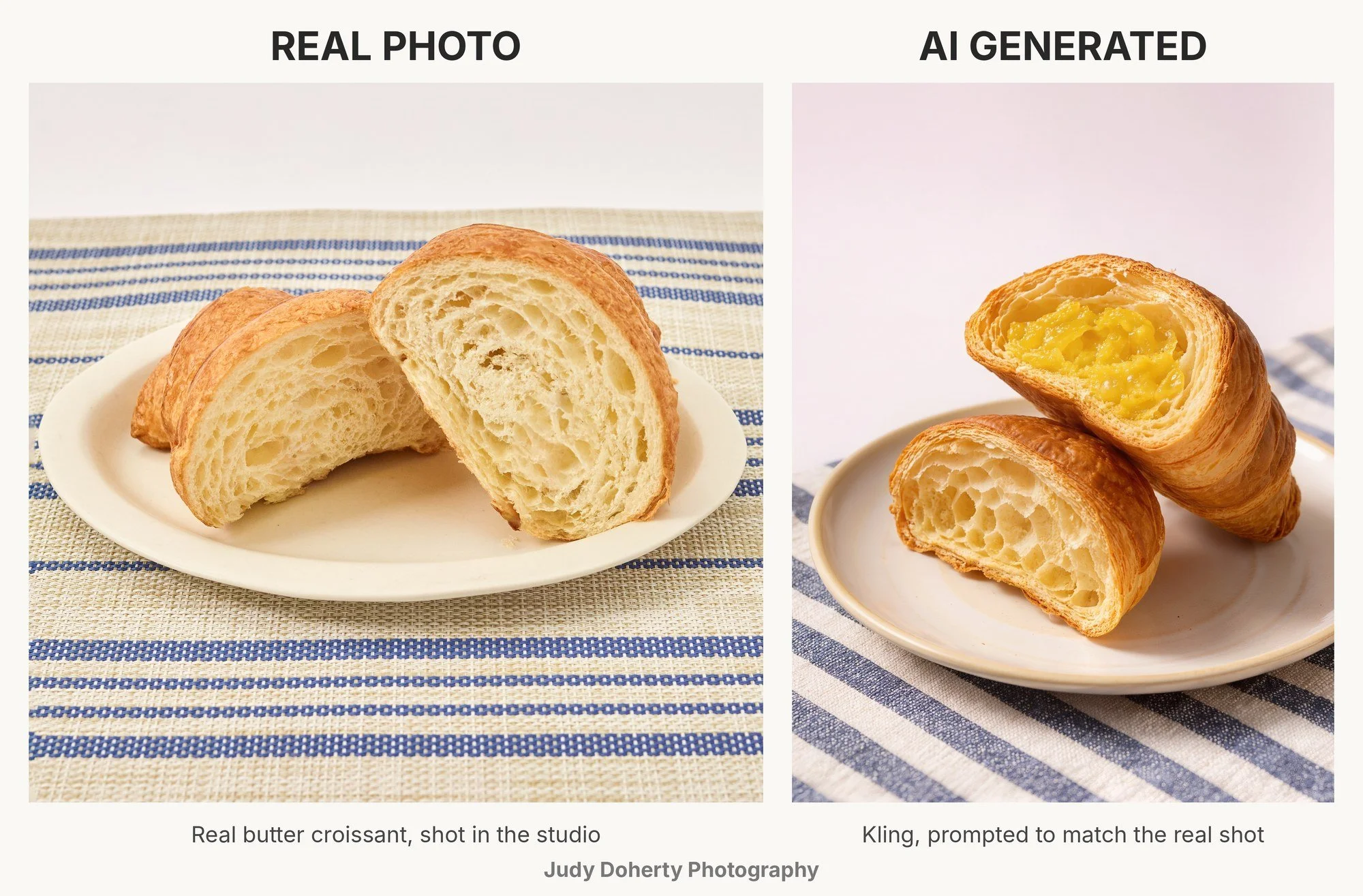
We asked AI to match the real shot: a plain butter croissant sliced in half on a cream plate with a striped linen. The real croissant shows an irregular, open crumb with thin, stretchy layers. The AI version added a yellow filling nobody asked for, gave the crumb a too-perfect honeycomb pattern, and balanced one half in a way a real croissant wouldn't sit.
Round 3: Strawberry s'more
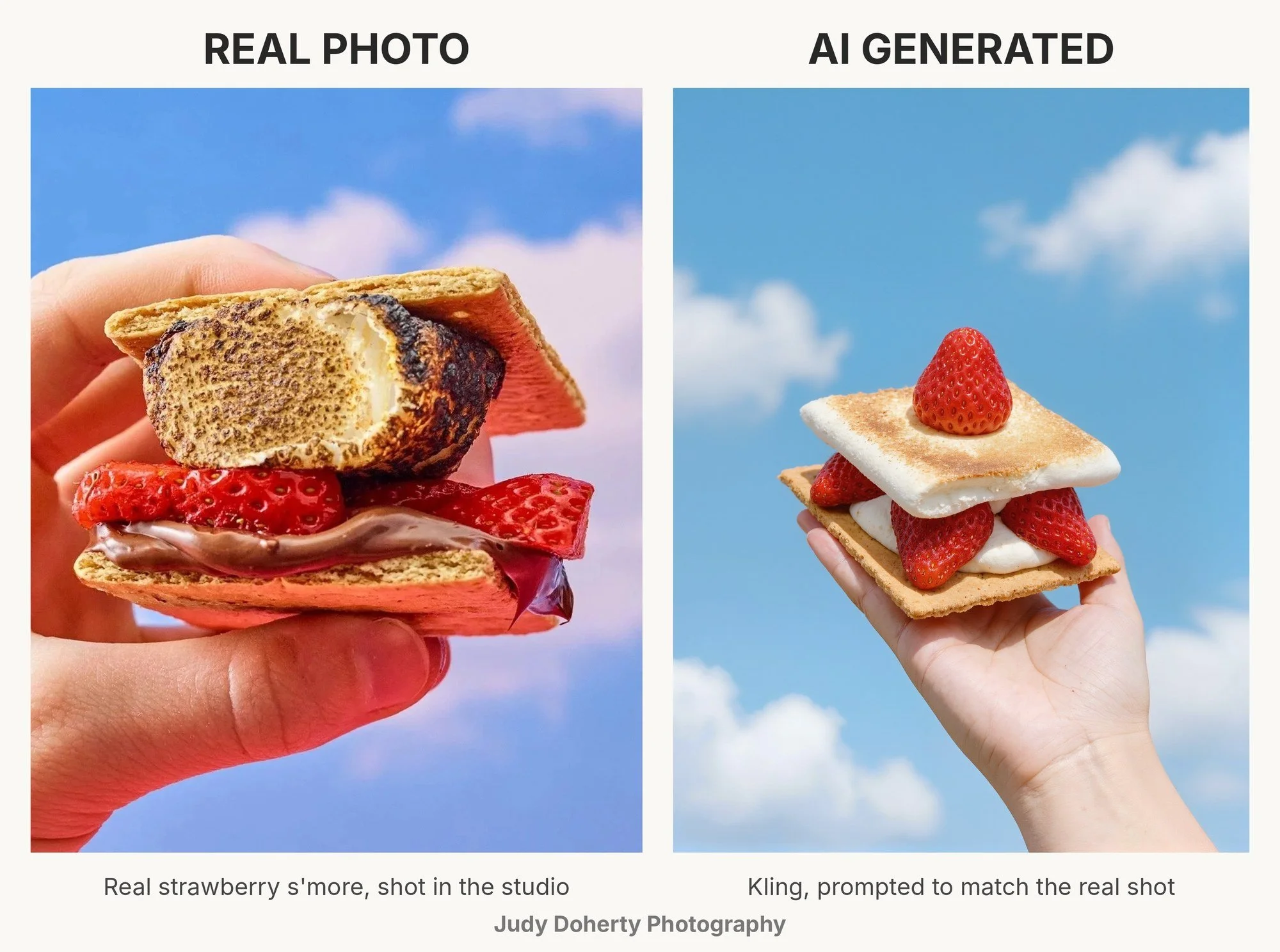
The real s'more has a charred, gooey marshmallow, sliced strawberries, and melted Nutella dripping off the edge, squeezed in a hand against the sky. The AI version turned the marshmallow into a flat, barely toasted slab, left out the chocolate, balanced a whole strawberry on top, and laid the s'more on a stiff, open palm.
Round 4: Berry-glazed cruller
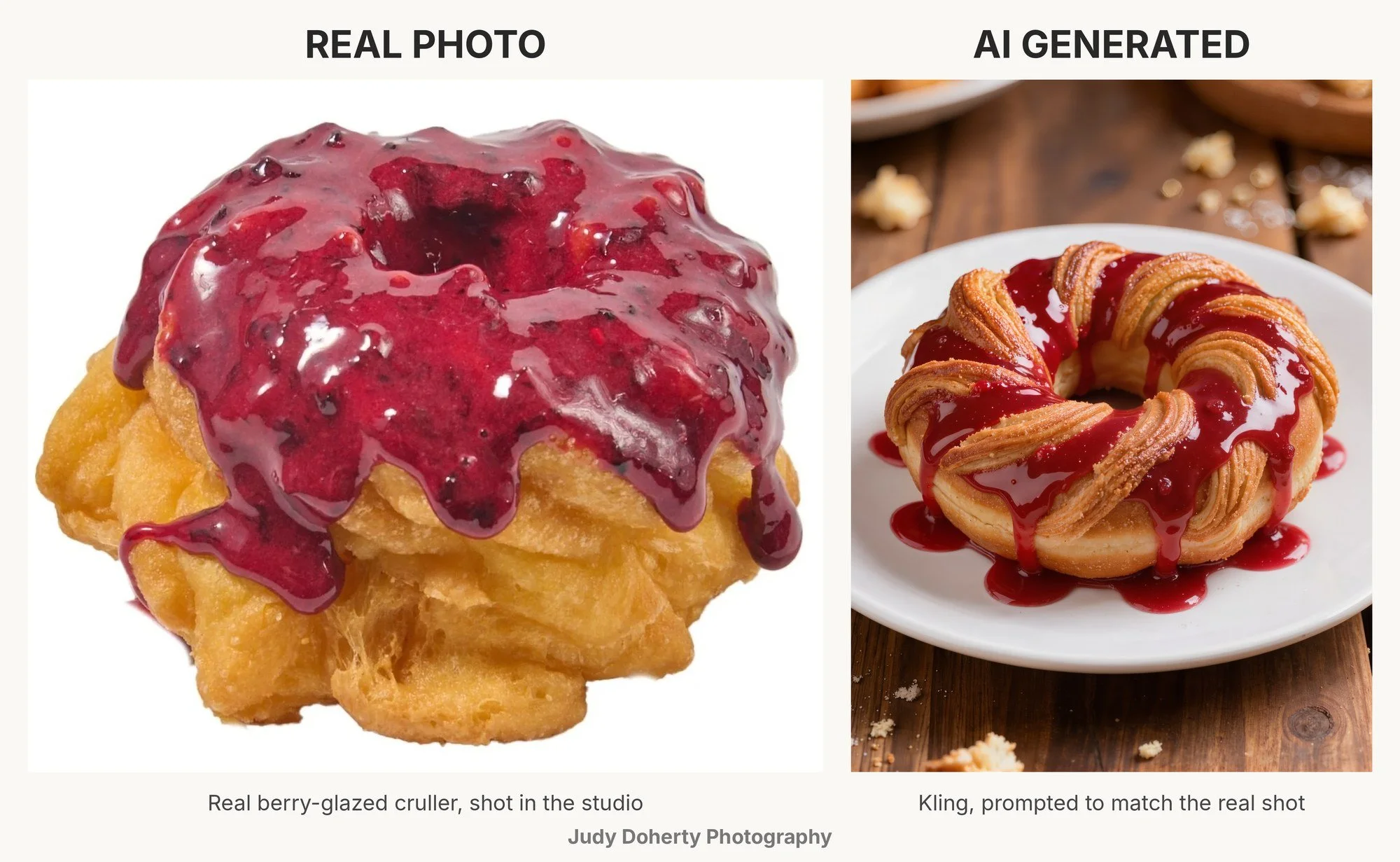
This is from our favorite donut shoot of all time. The real cruller has a thick, glossy berry glaze with real fruit bits, drips running down craggy fried ridges and airy, stretchy dough peeking through. The AI cruller looks like a twisted pastry ring, not a cruller, with a thin, candy-red glaze that pools on the plate like syrup.
Round 5: Grass-fed prime rib
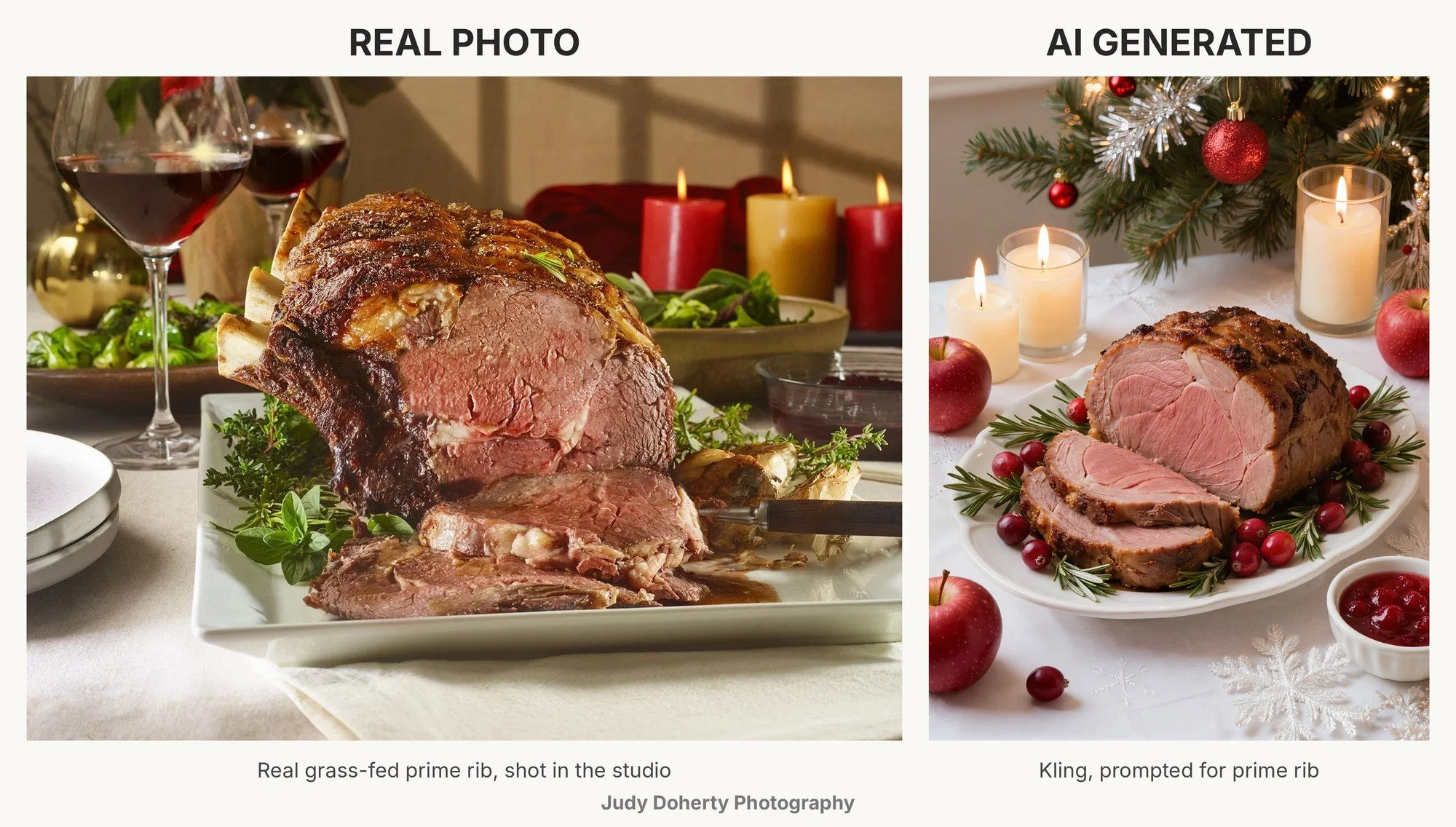
This one is grass-fed beef from our favorite client, Pomponio Ranch, shot at the end of an e-commerce day so they would also have a recipe and a real lifestyle image of the beef they work so hard to raise sustainably. We had exactly one roast, so there was no second chance, and we nailed the temperature in one go: a rosy, even pink from edge to edge, a deep garlicky, peppery, brown crust, and real bones. It was so real we ate it after the shoot. For the AI version, we asked for prime rib, and it looks like it got drunk and found a ham: pale pink, smooth, pork-like slices, no bones, no marbling.
The results: real food photos win all five rounds
AI missed the details that make food look delicious every time: the browned edges, the open crumb, the gooey melt, the real glaze, the perfect medium-rare. It added things nobody asked for, left out key ingredients, and in one round served the wrong meat. Shoppers know what a real pie, croissant, s'more, cruller, and prime rib look like, and an AI version promises a product that doesn't exist. For a food brand, that's the difference between "I want that" and scrolling past.
Why real is better for food: images in the age of AI search
Shoppers now find products through Google, AI chat, Amazon, and social feeds all at once, and every one of those places runs on your product images. AI tools read, show, and recommend real photos and videos of your product. The more angles, uses, and settings you give them, the more often your product shows up.
The good news: you don't need a new strategy. You need a full, honest image library that works everywhere.
What GEO means for your brand
GEO, or generative engine optimization, is making your brand easy for AI tools to find, understand, and recommend. SEO helps you rank on a list of links. GEO helps you get named in the answer.
When someone asks an AI tool "what's a good high-protein snack for kids' lunches," it pulls from product pages, retailer listings, recipes, reviews and images. Brands with clear, complete content get mentioned. Brands with one packshot and a short description get skipped.
People still use Google too. Most shoppers use both, asking AI for ideas and then searching or clicking through to buy. So GEO doesn't replace your other channels. It sits on top of them, and good images feed them all.
AI search is visual now
Shoppers are searching with pictures as much as with words. Google says Lens now handles more than 25 billion visual searches a month, and about one in five has shopping intent. Someone snaps a photo of a snack in a friend's pantry and gets matching products in seconds.
Here is where your images show up today:
Google AI Mode and AI Overviews show product images right in the answer, pulled from Google's Shopping Graph.
Google Lens matches a shopper's photo to the product images it already knows.
Amazon's Rufus assistant reads your listing images along with your text to answer shopper questions.
ChatGPT, Gemini and Perplexity show product cards and images when people ask for recommendations.
Social and retail media (Instagram, Pinterest, TikTok, Walmart, Instacart) run on images and short video.
AI tools can only match and recommend what they can see. If your only photo is a front-of-pack shot, an AI tool has nothing to show when someone asks for a lunchbox idea, a party drink or a quick weeknight dinner.
Google still drives most of the clicks to brand websites. Ahrefs found ChatGPT sends about 190 times less traffic than Google. So the goal is to be seen in the AI answer and to be the page people click on Google. The same images do both jobs.
The four shots every CPG brand needs
Each type of photo answers a different question a shopper, or an AI tool, is asking. Together they tell the full story of your product.
Clean on white shows the exact pack, label, and size from every angle. It answers "Is this the product I'm looking for?" and works hardest on Amazon, Walmart, Google Shopping, Lens matching, and retailer sell sheets. Retailers require it, so shoot every face of the pack with the label, nutrition panel, and claims readable.
In situ shows the product in its real setting: pantry, fridge, lunchbox, bar cart, gym bag. It answers "Where does this fit in my life?" and gives AI tools context. A protein bar in a gym bag tells the algorithm, and the shopper, what the product is for.
Lifestyle shows real people enjoying it: hands, moments, mood. It answers "Is this for someone like me?" These images build trust and stop the scroll on social, ads, email, and website hero images.
Recipe and serving shows the product made into a dish, drink, or snack, plus the recipe. It answers "What can I make with this?" Recipes are a GEO gift: people ask AI what to cook every day, and a recipe page with real photos gives AI something useful to quote and gives Google a page worth ranking.
Add video to the mix
Short product video works on almost every channel your customers use. A 10- to 30-second clip of a pour, an unwrap, or a recipe coming together does what a still can't: it shows texture, size, and how easy the product is to use.
Google owns YouTube, and its videos appear in Google results and AI answers.
Amazon lets brands add video to listings and Sponsored Brands ads.
Instagram, TikTok, and Pinterest favor short video in their feeds.
Your website keeps visitors longer with a quick product or recipe video.
Plan video and stills on the same shoot day. One set, one styled product, and one crew give you a full library for every channel. Here is a fun reel where we rigged the lights to create a sunrise effect while the steam coffee was pouring all in a crate of fresh apples for Pure Protein.
Why real photos beat AI-generated ones
AI image tools are great for brainstorming and mood boards. For the images that actually sell your product, a real studio still gets you to a finished, accurate, usable image faster and with less risk. Here's why.
Faster to a final image. On set, you see every shot live on a big screen as it's taken. Want a different garnish, angle or color of napkin? It changes in minutes. With AI, each new idea means another round of prompts, then retouching to fix warped labels and odd details. A good studio can try ten creative ideas in the time it takes to fix one AI image.
Creative ideas that only come from the room. A drip, a crumb falling the right way or a happy accident with light can't be prompted. A photographer and food stylist working with real food find shots no one planned.
Big, sharp files that hold up. Real camera files are large and crisp, so you can crop for a banner, a square post, a tall story or a printed sell sheet without losing quality. Nothing stretches, shifts or distorts when you resize.
Your label stays your label. AI tools often warp pack shapes, misspell words and invent text. Your nutrition panel, claims and logo have to be exactly right on every image.
Retailers and Google check. Amazon asks for a professional photo of the actual product as the main image. Google Merchant Center requires AI-generated images to keep their AI labels and metadata, and many social platforms tag AI images for viewers.
You own it. The U.S. Copyright Office has said images made entirely by AI can't be copyrighted. Real photography is licensed to your brand, so a competitor can't freely reuse it.
Real food looks delicious. Steam, a melt, a fizz, condensation on a can: shoppers know what these look like. AI food tends to look too smooth, too perfect and a little plastic, and people can feel it even when they can't say why.
Mindfully messy and relatable. A few crumbs on the board, a drip down the glass, a half-eaten bite. Styled imperfection makes food feel real and makes shoppers want to dig in. Brands that rely only on generated images often end up with pictures that feel off or overly photoshopped.
Recipes that work. A recipe photo should show a dish someone can actually make from your product. Real recipes are tested in a kitchen before they're photographed.
One consistent library. A studio can match lighting and style across every SKU and reshoot new flavors to fit right in, so your whole line looks like a family.
Shoppers trust it more. In a Getty Images survey of more than 7,500 people, 90% said they want to know if an image is AI-made. A 2026 UK survey by Photoroom found 63% say inconsistent images make a seller seem unreliable.
Real and AI can work together. A strong library of real photos gives you accurate images to build on for quick seasonal edits or social variations. Start with the real thing, and every other tool works better.
A quick image checklist for AI search
Clean on-white shots of every SKU, all sides, label readable
At least two in situ shots per product showing where it's used
Lifestyle images with real people and real moments
Recipe or serving photos, with the recipe written out on your site
Short videos for YouTube, Amazon and social
Product names in your file names and alt text
The same images on your website, Amazon, Google Merchant Center and retailer pages
Images updated whenever packaging changes
You don't have to do it all at once. Start with your best sellers and build from there. One well-planned shoot day can cover white, in situ, lifestyle, recipe and video for several products.
Want help planning your image library? Book a free call and we'll map out the shots that will work hardest for your brand across search, AI and every channel you sell on. You can also see the CPG content libraries we create and our CPG image style reel.
Sources
Google Lens tops 25 billion monthly searches (Scalevise, citing Google, 2026)
Google adds visual search to AI Mode (TechRadar, 2025)
ChatGPT sends 190x less traffic than Google (PPC Land, citing Ahrefs, 2026)
Consumers dislike brands using AI images of people (Campaign, citing Getty Images, 2024)
UK shoppers wary of AI product images (IT Brief, citing Photoroom, 2026)
Image link requirements, including AI-generated images (Google Merchant Center Help)
Copyright and Artificial Intelligence, Part 2: Copyrightability (U.S. Copyright Office, 2025)
Read more from the library
Explore more: CPG Photography, Content, Motion